सामाजिक अवस्था
शिक्षा, स्वास्थ्य, खानेपानी र सांस्कृतिक विकास
5.1 Education and Human Resource Development
Education plays a major role in the social and economic development of any country. It is considered an indicator of human development. In this context, the educational status of the municipality is being presented here. Education is the cornerstone of development, and it is a universally accepted principle that through education, the latent talents within individuals can be developed, bringing positive changes to society and the nation as a whole. The education sector plays an indispensable role in creating aware, disciplined, and productive human resources. In planning, the education sector has been adopted as a powerful means of human resource development for poverty alleviation and comprehensive development. The state's policy also aims to develop education as the main infrastructure for development, making it accessible and effective.
Part 3, Article 31 of the Constitution of Nepal 2072 provides the following provisions regarding the fundamental right to education:
1. Every citizen shall have the right to access basic education.
2. Every citizen shall have the right to receive free and compulsory basic education from the state, and free secondary education.
3. Citizens with disabilities and economically disadvantaged citizens shall have the right to receive free higher education as per law.
4. Visually impaired citizens shall have the right to receive free education through Braille script, and citizens with hearing and speech disabilities shall have the right to receive free education through sign language as per law.
5. Every Nepali community residing in Nepal shall have the right to receive education in their mother tongue and to open and operate schools and educational institutions as per law.
Despite extensive debates on the constitution and planning, a comparative study in the world shows that notable progress has not been made in our education sector. Education must bring practical changes in knowledge and skills, advocate for the backward, poor, and deprived classes, and realize the vision of making the country prosperous by standing for innocent children and the voiceless. The characteristic of quality education is to help develop fundamental comprehensive aspects such as leadership capacity needed for the country, the tendency to learn and teach tirelessly, social and human values, and self-confidence. Such education must have adequacy of analytical and original thinking. Prescribed learning alone is not quality. Today, quality education is needed to use science practically for behavioral change, faith in labor, life-relevant research, contextual love for the country and culture, and ethical responsibility. Quality development of education can raise the standard of living of the people through employment opportunities, industrial development, access to facilities, expansion of technology, productive agriculture, income-oriented business, and abundant utilization of local resources, which strengthens the economy of the municipality and provides significant support to social development.
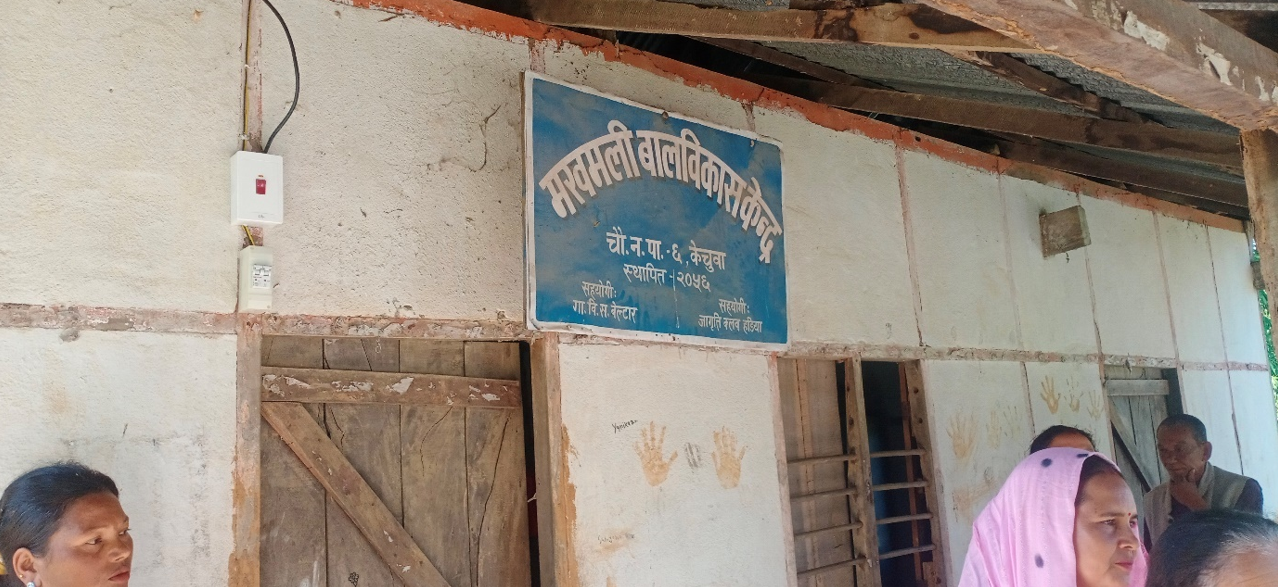
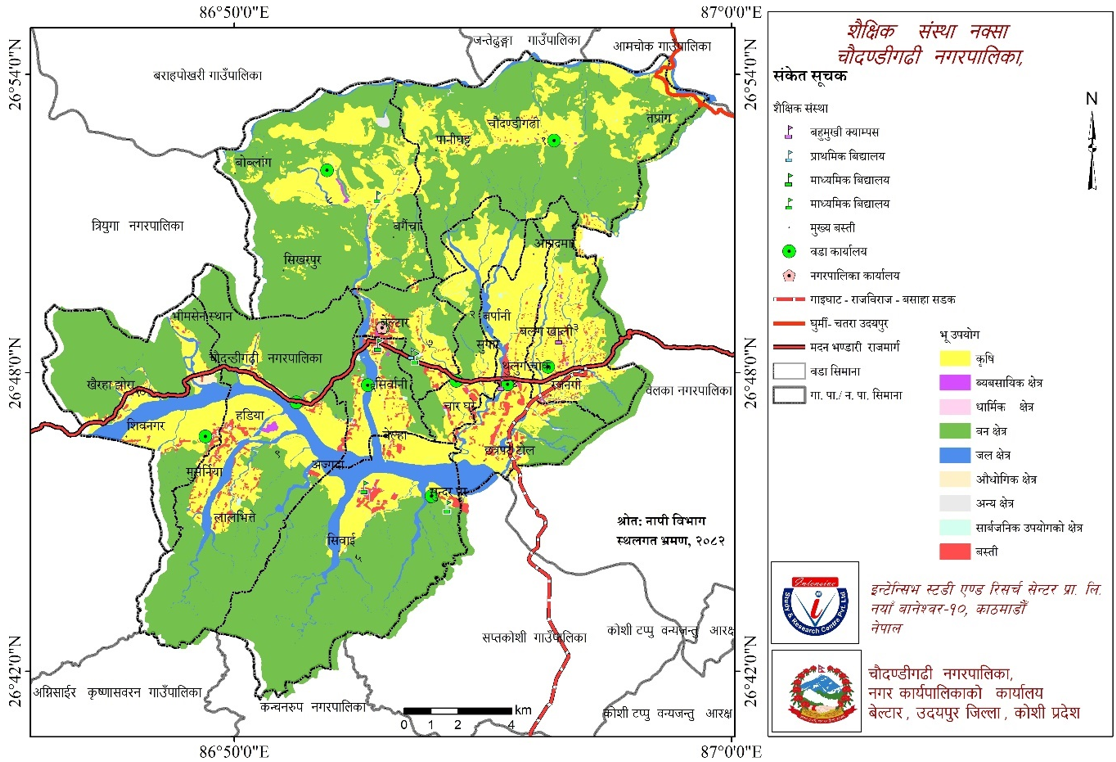
Map No. 7: Municipality Education Sector Map
5.1.1 Literacy of Population Aged Five Years and Above
Table No. 40: Details of Literacy of Population Aged 5 Years and Above by Ward
| Ward | Gender | Can Read and Write | Can Only Read | Cannot Read or Write | Not Mentioned | Total |
|---|---|---|---|---|---|---|
| 1 | Total | 2,285 | 1 | 868 | 0 | 3,154 |
| Male | 1,210 | 1 | 337 | 0 | 1,548 | |
| Female | 1,075 | 0 | 531 | 0 | 1,606 | |
| 2 | Total | 3,551 | 21 | 1,115 | 1 | 4,688 |
| Male | 1,975 | 4 | 365 | 0 | 2,144 | |
| Female | 1,576 | 17 | 750 | 1 | 2,344 | |
| 3 | Total | 2,931 | 10 | 757 | 0 | 3,698 |
| Male | 1,442 | 4 | 258 | 0 | 1,704 | |
| Female | 1,489 | 6 | 499 | 0 | 1,994 | |
| 4 | Total | 5,146 | 23 | 1,255 | 0 | 6,424 |
| Male | 2,557 | 8 | 294 | 0 | 2,859 | |
| Female | 2,589 | 15 | 961 | 0 | 3,565 | |
| 5 | Total | 4,325 | 6 | 1,483 | 0 | 5,814 |
| Male | 2,224 | 4 | 485 | 0 | 2,713 | |
| Female | 2,101 | 2 | 998 | 0 | 3,101 | |
| 6 | Total | 4,245 | 3 | 903 | 0 | 5,151 |
| Male | 2,125 | 2 | 252 | 0 | 2,379 | |
| Female | 2,120 | 1 | 651 | 0 | 2,772 | |
| 7 | Total | 4,762 | 25 | 906 | 0 | 5,693 |
| Male | 2,412 | 11 | 217 | 0 | 2,670 | |
| Female | 2,350 | 14 | 659 | 0 | 3,023 | |
| 8 | Total | 2,628 | 5 | 684 | 0 | 3,917 |
| Male | 1,347 | 2 | 304 | 0 | 1,653 | |
| Female | 1,281 | 3 | 580 | 0 | 1,844 | |
| 9 | Total | 5,203 | 18 | 1,737 | 0 | 6,958 |
| Male | 2,691 | 8 | 539 | 0 | 3,238 | |
| Female | 2,509 | 8 | 1,206 | 0 | 3,723 | |
| 10 | Total | 3,369 | 6 | 1,025 | 0 | 4,392 |
| Male | 1,713 | 2 | 299 | 0 | 2,014 | |
| Female | 1,656 | 6 | 726 | 0 | 2,378 | |
| Total | Total | 19,499 | 46 | 3,472 | 0 | 23,017 |
| Male | 18,946 | 72 | 7,441 | 1 | 26,460 | |
| Female | 38,445 | 118 | 10,913 | 1 | 49,477 | |
| Percentage | 77.70 | 0.24 | 22.06 | 0.00 | 100 | |
Source: National Census, 2078
Literacy indicates the overall human development index beyond the ability to read and write. Out of a total population of 49,477 aged 5 years and above in the municipality, 38,445, i.e., 77.70 percent, are literate. The literate population that can only read is 118, i.e., 0.24 percent, while the population that can neither read nor write (both skills lacking, i.e., illiterate) is 10,913, i.e., 22.06 percent. Detailed ward-wise details are mentioned in the table.
Ward-wise Literacy of Population Aged 5 Years and Above
a) Literacy Status of Population Based on Formal Education
UNESCO defined in 1956 that a person who can generally read, write, and perform basic mathematical addition and subtraction in daily life is considered literate. Nepal is also conducting a literacy campaign based on this definition. Out of the total population aged 5 to 25 years in this municipality, 12,105, i.e., 72.93 percent, are currently attending school and college, 3,783, i.e., 22.96 percent, have previously attended school and college, and 675, i.e., 4.10 percent, have never received formal education in school or college. Detailed details are presented in the table below.
Table No. 41: Literacy Status of Population Based on Formal Education
| Ward | Gender | Currently Attending School/College | Previously Attended | Never Attended | Not Mentioned | Total |
|---|---|---|---|---|---|---|
| 1 | Total | 805 | 402 | 122 | 0 | 1,329 |
| Male | 405 | 260 | 65 | 0 | 670 | |
| Female | 400 | 202 | 57 | 0 | 659 | |
| 2 | Total | 1,200 | 472 | 78 | 0 | 1,750 |
| Male | 563 | 239 | 32 | 0 | 834 | |
| Female | 637 | 232 | 46 | 0 | 918 | |
| 3 | Total | 942 | 325 | 33 | 1 | 1,300 |
| Male | 463 | 98 | 15 | 0 | 577 | |
| Female | 489 | 165 | 17 | 0 | 673 | |
| 4 | Total | 1,482 | 575 | 60 | 0 | 2,024 |
| Male | 757 | 207 | 28 | 0 | 983 | |
| Female | 725 | 269 | 32 | 0 | 1,042 | |
| 5 | Total | 1,682 | 468 | 120 | 0 | 1,869 |
| Male | 824 | 220 | 62 | 0 | 923 | |
| Female | 858 | 248 | 78 | 0 | 947 | |
| 6 | Total | 1,279 | 430 | 78 | 0 | 1,567 |
| Male | 652 | 235 | 40 | 0 | 827 | |
| Female | 627 | 164 | 10 | 0 | 844 | |
| 7 | Total | 1,763 | 339 | 25 | 0 | 1,726 |
| Male | 771 | 151 | 15 | 0 | 888 | |
| Female | 0 | 145 | 10 | 0 | 844 | |
| 8 | Total | 964 | 351 | 21 | 0 | 1,337 |
| Male | 455 | 184 | 14 | 0 | 702 | |
| Female | 507 | 168 | 10 | 0 | 644 | |
| 9 | Total | 1,922 | 305 | 91 | 0 | 2,129 |
| Male | 455 | 115 | 39 | 0 | 980 | |
| Female | 507 | 145 | 52 | 0 | 1,149 | |
| 10 | Total | 1,139 | 317 | 57 | 0 | 1,399 |
| Male | 578 | 141 | 23 | 0 | 634 | |
| Female | 543 | 145 | 23 | 0 | 777 | |
| Total | Total | 12,075 | 3,783 | 675 | 1 | 16,307 |
| Male | 6,020 | 1,784 | 321 | 1 | 8,040 | |
| Female | 6,055 | 2,058 | 354 | 0 | 8,364 | |
| Percentage | 72.93 | 22.96 | 4.10 | 0.01 | 100 | |
Source: National Census, 2078
5.1.2 Educational Institutions/Schools and Student Details by Level
a) Details of Community Schools
| SN | School Name | Location |
|---|---|---|
| 1. | Basic School Siwai Belwa | Chaudandigadhi–5 |
| 2. | Basic School Kheraha | Chaudandigadhi–10 |
| 3. | Ideal Basic School Agraha | Chaudandigadhi–8 |
| 4. | Balmukhi Basic School Ajagar | Chaudandigadhi–9 |
| 5. | Baljyoti Basic School Badelpani | Chaudandigadhi–3 |
| 6. | Basic School Gangau | Chaudandigadhi–1 |
| 7. | Belka Basic School Hatisar | Chaudandigadhi–2 |
| 8. | Shimsen Ideal Basic School Devdhar | Chaudandigadhi–10 |
| 9. | Buddha Janata Pri. School Gangate | Chaudandigadhi–2 |
| 10. | Gausaikanya Basic School Simaltar | Chaudandigadhi–8 |
| 11. | Jarbaidhari Janata Basic School Ranitar | Chaudandigadhi–1 |
| 12. | Jatyajna Secondary School Ajjungare | Chaudandigadhi–4 |
| 13. | Janajyoti Basic School Panchwari Tole | Chaudandigadhi–9 |
| 14. | Janajyoti Basic School Amalchauri | Chaudandigadhi–4 |
| 15. | Janakalyan Basic School Hatisar | Chaudandigadhi–2 |
| 16. | Janasewa Basic School Sawali Tole | Chaudandigadhi–4 |
| 17. | Janata Ideal Secondary School Kalikhola | Chaudandigadhi–4 |
| 18. | Janata Secondary School Hadiya | Chaudandigadhi–9 |
| 19. | Janata Secondary School Lokentar | Chaudandigadhi–8 |
| 20. | Janata Basic School Chhunguwa | Chaudandigadhi–1 |
| 21. | Ushkalabati Pri. School Phali tar | Chaudandigadhi–8 |
| 22. | Jyoti Secondary School Beltar | Chaudandigadhi–6 |
| 23. | Kalika Secondary School Siwani | Chaudandigadhi–6 |
| 24. | Kodedevi Basic School Jhorpata | Chaudandigadhi–2 |
| 25. | Kokan Basic School Dekachauri | Chaudandigadhi–5 |
| 26. | Lokmarghi Secondary School Khairakhos | Chaudandigadhi–10 |
| 27. | Madaratna Bishwalyah Kuran Pri. School Sipai | Chaudandigadhi–5 |
| 28. | Mahadebdhar Basic School Dewaha | Chaudandigadhi–4 |
| 29. | Padmani Basic School Beltar | Chaudandigadhi–7 |
| 30. | Raktakala Pri. School Mugare | Chaudandigadhi–2 |
| 31. | Saranath Basic School Bhutke | Chaudandigadhi–3 |
| 32. | Sagarnath Secondary School Bholeni | Chaudandigadhi–3 |
| 33. | Sarada Basic School Siltipur | Chaudandigadhi–8 |
| 34. | Saraswati Secondary School Saba | Chaudandigadhi–8 |
| 35. | Sarada Secondary School Karahare | Chaudandigadhi–1 |
| 36. | Shree Bhanawati Secondary School Musultibha | Chaudandigadhi–9 |
| 37. | Shree Jarbikas Secondary School Bibha | Chaudandigadhi–9 |
| 38. | Shree Narad Ideal Secondary School Barshenda | Chaudandigadhi–4 |
| 39. | Shree Secondary School Arupal | Chaudandigadhi–3 |
| 40. | Shree Secondary School Sipai | Chaudandigadhi–5 |
| 41. | Shree Shiv Secondary School Sipai Sundarpur | Chaudandigadhi–5 |
| 42. | Shree Dhanpokhari Secondary School Jwamire | Chaudandigadhi–9 |
| 43. | Siukali Basic School Bhire | Chaudandigadhi–2 |
| 44. | Siddeshwari Secondary School Musultibha | Chaudandigadhi–9 |
| 45. | Siddevi Secondary School Mardibas | Chaudandigadhi–2 |
b) Details of Institutional Schools
| SN | School Name | Location | Students |
|---|---|---|---|
| 1. | Balvikas Montessori School | Chaudandigadhi–7 | 38 |
| 2. | Beria Kids Pre School | Chaudandigadhi–4 | 54 |
| 3. | Bhumi Chetan English School Beltar | Chaudandigadhi–7 | 182 |
| 4. | Bright Future Academy Chaudandigadhi | Chaudandigadhi–3 | 919 |
| 5. | Bright Future National English Boarding School (0–8) | Chaudandigadhi–8 | 755 |
| 6. | Buddha Niketan English Boarding School | Chaudandigadhi–4 | 920 |
| 7. | Buddharatnawa Vidya Niketan | Chaudandigadhi–9 | 281 |
| 8. | Chando Bright Future English Boarding School | Chaudandigadhi–9 | 922 |
| 9. | Deurali English Boarding School Siswani | Chaudandigadhi–6 | 202 |
| 10. | Eric English Boarding School | Chaudandigadhi–2 | 55 |
| 11. | Kanchanjangha English Boarding School Beltar | Chaudandigadhi–7 | 276 |
| 12. | Marigold Academy Beltar | Chaudandigadhi–7 | 202 |
| 13. | Moti Memorial English Boarding School Barshenda | Chaudandigadhi–4 | 542 |
| 14. | Newton Academy | Chaudandigadhi–2 | 263 |
| 15. | Pavin Memorial Basic English Boarding School | Chaudandigadhi–4 | 235 |
| 16. | Purushad Academy | Chaudandigadhi–7 | 349 |
| 17. | Puma English Boarding School | Chaudandigadhi–6 | 559 |
| 18. | Sagarnath Chekpreddy English Boarding School | Chaudandigadhi–7 | 725 |
| 19. | Sukdev Memorial Academy | Chaudandigadhi–5 | 964 |
| 20. | Sudarshan English Boarding School | Chaudandigadhi–10 | 474 |
| 21. | Trishuli English Boarding School | Chaudandigadhi–9 | 556 |
| 22. | Vidya Public English Boarding School Hadiya | Chaudandigadhi–10 | 956 |
c) Details of Community Child Development Centers
| SN | Ward No. | School Name | Female | Male | Other | Total |
|---|---|---|---|---|---|---|
| 1 | 5 | Basic School Siwai | 11 | 15 | 0 | 26 |
| 2 | 10 | Basic School Kheraha | 12 | 11 | 0 | 23 |
| 3 | 8 | Ideal Basic School | 2 | 6 | 0 | 8 |
| 4 | 9 | Balmukhi Basic School | 9 | 6 | 0 | 15 |
| 5 | 3 | Baljyoti Basic School | 9 | 6 | 0 | 15 |
| 6 | 1 | Basic School | 4 | 12 | 0 | 16 |
| 7 | 2 | Belka Basic School | 5 | 5 | 0 | 10 |
| 8 | 10 | Bhimsen Ideal Basic School | 6 | 8 | 0 | 14 |
| 9 | 2 | Buddha Janata Pri. School | 25 | 15 | 0 | 40 |
| 10 | 8 | Gaurikanya Basic School | 5 | 8 | 0 | 13 |
| 11 | 1 | Jaleshwor Janata Basic School | 5 | 6 | 0 | 11 |
| 12 | 4 | Jalpajana Secondary School | 6 | 16 | 0 | 22 |
| 13 | 9 | Janajyoti Basic School | 12 | 7 | 0 | 19 |
| 14 | 4 | Janajyoti Basic School Amalchauri | 14 | 11 | 0 | 25 |
| 15 | 3 | Janakalyan Basic School | 16 | 13 | 0 | 29 |
| 16 | 4 | Janasewa Basic School | 9 | 10 | 0 | 19 |
| 17 | 4 | Janata Ideal Secondary School | 4 | 2 | 0 | 6 |
| 18 | 9 | Janata Secondary School | 50 | 45 | 0 | 95 |
| 19 | 8 | Janata Secondary School | 16 | 13 | 0 | 29 |
| 20 | 1 | Janata Basic School Chhuila | 6 | 9 | 0 | 15 |
| 21 | 8 | Jayakaladevi Pri. School Kalitar | 15 | 9 | 0 | 24 |
| 22 | 6 | Jyoti Secondary School | 29 | 26 | 0 | 55 |
| 23 | 6 | Kalika Secondary School | 9 | 4 | 0 | 13 |
| 24 | 2 | Kauvaidevi Basic School | 23 | 24 | 0 | 47 |
| 25 | 5 | Kokan Basic School | 7 | 9 | 0 | 16 |
| 26 | 10 | Lauwagadhi Secondary School | 7 | 8 | 0 | 15 |
| 27 | 5 | Madrasa Bismillah Kuran Pri. School | 5 | 6 | 0 | 11 |
| 28 | 4 | Mahadeveshwor Basic School Basaha | 6 | 8 | 0 | 14 |
| 29 | 7 | Panchami Basic School | 7 | 3 | 0 | 10 |
| 30 | 2 | Raktamala Pri. School Sudhare | 9 | 9 | 0 | 18 |
| 31 | 7 | Sagarmatha Basic School | 11 | 8 | 0 | 19 |
| 32 | 3 | Sagarmatha Secondary School | 8 | 4 | 1 | 13 |
| 33 | 8 | Sarada Basic School | 4 | 9 | 0 | 13 |
| 34 | 8 | Saraswati Secondary School | 1 | 6 | 0 | 7 |
| 35 | 1 | Sarada Secondary School | 8 | 6 | 0 | 14 |
| 36 | 9 | Shree Bhagawati Secondary School | 14 | 13 | 0 | 27 |
| 37 | 9 | Shree Janabikas Secondary School | 13 | 9 | 0 | 22 |
| 38 | 4 | Shree Narad Ideal Secondary School | 3 | 4 | 0 | 7 |
| 39 | 3 | Shree Secondary School Ampal | 7 | 6 | 0 | 13 |
| 40 | 5 | Shree Secondary School Siwai | 34 | 20 | 0 | 54 |
| 41 | 5 | Shree Shiv Secondary School | 24 | 13 | 0 | 37 |
| 42 | 9 | Shree Thanpokhari Secondary School | 8 | 11 | 0 | 19 |
| 43 | 2 | Siddhakali Basic School | 20 | 10 | 0 | 30 |
| 44 | 9 | Siddheshwori Secondary School | 16 | 10 | 0 | 26 |
| 45 | 2 | Simhadevi Secondary School | 5 | 10 | 0 | 15 |
d) Details of Institutional Child Development Centers
| SN | Ward No. | School Name | Female | Male | Other | Total |
|---|---|---|---|---|---|---|
| 1 | 7 | Balwatika Vidya Niketan School | 19 | 16 | 0 | 35 |
| 2 | 7 | Bhupu Sainik English School Beltar | 19 | 31 | 0 | 50 |
| 3 | 3 | Bright Future Academy Chaudandigadhi-3 | 19 | 17 | 0 | 36 |
| 4 | 8 | Bright Future National English Boarding School (0–8) | 10 | 10 | 0 | 20 |
| 5 | 4 | Buddha Niketan English Boarding School | 18 | 26 | 0 | 44 |
| 6 | 9 | Buddharalal Vidya Niketan | 34 | 49 | 0 | 83 |
| 7 | 9 | Chandi Bright Future English Boarding School | 29 | 34 | 0 | 63 |
| 8 | 6 | Deurali English Boarding School Siswani | 21 | 23 | 0 | 44 |
| 9 | 9 | Atic English Boarding School | 30 | 39 | 0 | 69 |
| 10 | 7 | Kanchanjangha English Boarding School Beltar | 17 | 38 | 0 | 55 |
| 11 | 7 | Marigold Academy Beltar | 15 | 32 | 0 | 47 |
| 12 | 4 | Mother Blessing English Boarding School Basaha | 16 | 18 | 0 | 34 |
| 13 | 4 | Moti Memorial English Boarding School Barshenda | 45 | 40 | 0 | 85 |
| 14 | 2 | Newton Academy | 0 | 0 | 0 | 0 |
| 15 | 4 | Pavitra Memorial Basic English Boarding School | 25 | 37 | 0 | 62 |
| 16 | 7 | Puruhang Academy | 42 | 44 | 0 | 86 |
| 17 | 6 | Puma English Boarding School | 34 | 57 | 0 | 91 |
| 18 | 7 | Sagarmatha Secondary English Boarding School | 31 | 63 | 0 | 94 |
| 19 | 5 | Sukdev Memorial Academy | 37 | 42 | 0 | 79 |
| 20 | 10 | Sudarshan English Boarding School | 32 | 40 | 0 | 72 |
| 21 | 9 | Trishakti English Boarding School | 22 | 42 | 0 | 64 |
| 22 | 10 | Triyuga Public English Boarding School Hadiya | 25 | 25 | 0 | 50 |
f) Details of Institutional Schools and Students
Table No. 6: Details of Institutional Schools and Students
| SN | School Name | ECD | Class 1-5 | Class 6-8 | Class 9-10 | Class 11-12 | Total | ||||||||||||
|---|---|---|---|---|---|---|---|---|---|---|---|---|---|---|---|---|---|---|---|
| F | M | T | F | M | T | F | M | T | F | M | T | F | M | T | F | M | T | ||
| 1 | Balwatika Vidya Niketan School | 19 | 16 | 35 | 11 | 8 | 19 | 0 | 0 | 0 | 0 | 0 | 0 | 0 | 0 | 0 | 30 | 24 | 54 |
| 2 | Bhupu Sainik English School Beltar | 19 | 31 | 50 | 36 | 35 | 71 | 16 | 28 | 44 | 8 | 18 | 26 | 0 | 0 | 0 | 79 | 112 | 191 |
| 3 | Bright Future Academy Chaudandigadhi-3 | 19 | 17 | 36 | 43 | 56 | 109 | 24 | 30 | 54 | 5 | 11 | 16 | 0 | 0 | 0 | 91 | 114 | 205 |
| 4 | Bright Future National English Boarding School (0–8) | 10 | 10 | 20 | 23 | 19 | 42 | 6 | 7 | 13 | 0 | 0 | 0 | 0 | 0 | 0 | 39 | 36 | 75 |
| 5 | Buddha Niketan English Boarding School | 18 | 26 | 44 | 56 | 53 | 109 | 21 | 18 | 39 | 3 | 4 | 7 | 0 | 0 | 0 | 98 | 101 | 199 |
| 6 | Budhurlal Vidya Niketan | 34 | 49 | 83 | 75 | 69 | 144 | 21 | 18 | 39 | 3 | 4 | 7 | 0 | 0 | 0 | 133 | 140 | 273 |
| 7 | Chandi Bright Future English Boarding School | 29 | 34 | 63 | 24 | 50 | 74 | 11 | 21 | 32 | 0 | 0 | 0 | 0 | 0 | 0 | 64 | 105 | 169 |
| 8 | Deurali English Boarding School Siruwani | 21 | 23 | 44 | 47 | 65 | 112 | 14 | 23 | 37 | 4 | 4 | 8 | 0 | 0 | 0 | 86 | 115 | 201 |
| 9 | Atic English Boarding School | 30 | 39 | 69 | 12 | 26 | 38 | 0 | 0 | 0 | 0 | 0 | 0 | 0 | 0 | 0 | 42 | 65 | 107 |
| 10 | Kanchanjangha English Boarding School Beltar | 17 | 38 | 55 | 46 | 60 | 106 | 13 | 34 | 47 | 8 | 14 | 22 | 0 | 0 | 0 | 84 | 146 | 230 |
| 11 | Marigold Academy Beltar | 15 | 32 | 47 | 45 | 48 | 93 | 17 | 13 | 30 | 5 | 11 | 16 | 0 | 0 | 0 | 82 | 104 | 186 |
| 12 | Mother Blessing English Boarding School Basaha | 16 | 18 | 34 | 17 | 21 | 38 | 1 | 4 | 5 | 0 | 0 | 0 | 0 | 0 | 0 | 34 | 43 | 77 |
| 13 | Moti Memorial English Boarding School Barshenda | 45 | 40 | 85 | 82 | 91 | 173 | 52 | 50 | 102 | 26 | 35 | 61 | 0 | 0 | 0 | 205 | 216 | 421 |
| 14 | Newton Academy | 0 | 0 | 0 | 50 | 31 | 81 | 35 | 22 | 57 | 8 | 6 | 14 | 0 | 0 | 0 | 93 | 59 | 152 |
| 15 | Pavitra Memorial Basic English Boarding School | 25 | 37 | 62 | 43 | 77 | 120 | 30 | 25 | 55 | 0 | 0 | 0 | 0 | 0 | 0 | 98 | 139 | 237 |
| 16 | Puruhang Academy | 42 | 44 | 86 | 69 | 80 | 149 | 37 | 48 | 85 | 12 | 22 | 34 | 0 | 0 | 0 | 160 | 194 | 354 |
| 17 | Puma English Boarding School | 34 | 57 | 91 | 91 | 127 | 218 | 64 | 65 | 129 | 24 | 48 | 72 | 7 | 7 | 14 | 220 | 304 | 524 |
| 18 | Sagarmatha Secondary English Boarding School | 31 | 63 | 94 | 79 | 151 | 238 | 76 | 95 | 171 | 37 | 49 | 86 | 26 | 36 | 62 | 249 | 402 | 651 |
| 19 | Sukdev Memorial Academy | 37 | 42 | 79 | 30 | 43 | 73 | 0 | 0 | 0 | 0 | 0 | 0 | 0 | 0 | 0 | 67 | 85 | 152 |
| 20 | Sudarshan English Boarding School | 32 | 40 | 72 | 57 | 73 | 130 | 6 | 4 | 10 | 0 | 0 | 0 | 0 | 0 | 0 | 95 | 117 | 212 |
| 21 | Trishakti English Boarding School | 22 | 42 | 64 | 23 | 38 | 61 | 0 | 0 | 0 | 0 | 0 | 0 | 0 | 0 | 0 | 45 | 80 | 125 |
| 22 | Triyuga Public English Boarding School Hadiya | 25 | 25 | 50 | 55 | 53 | 108 | 3 | 7 | 10 | 0 | 0 | 0 | 0 | 0 | 0 | 83 | 85 | 168 |
5.1.3 Details of Students Studying in Schools
Table No. 42: Details of Students Studying in Schools of Municipality
| SN | School Name | Student Count |
|---|---|---|
| 1 | Basic School Siwai Belwa | 146 |
| 2 | Basic School Kheraha | 54 |
| 3 | Ideal Basic School Agraha | 32 |
| 4 | Balmukhi Basic School Ajagar | 84 |
| 5 | Baljyoti Basic School Badelpani | 11 |
| 6 | Basic School Gangau | 121 |
| 7 | Belka Basic School Hatisar | 18 |
| 8 | Shimsen Ideal Basic School Devdhar | 97 |
| 9 | Buddha Janata Pri. School Gangate | 78 |
| 10 | Gausaikanya Basic School Simaltar | 64 |
| 11 | Jarbaidhari Janata Basic School Ranitar | 139 |
| 12 | Jatyajna Secondary School Ajjungare | 243 |
| 13 | Janajyoti Basic School Panchwari Tole | 43 |
| 14 | Janajyoti Basic School Amalchauri | 200 |
| 15 | Janakalyan Basic School Hatisar | 117 |
| 16 | Janasewa Basic School Sawali Tole | 16 |
| 17 | Janata Ideal Secondary School Kalikhola | 229 |
| 18 | Janata Secondary School Hadiya | 962 |
| 19 | Janata Secondary School Lokentar | 441 |
| 20 | Janata Basic School Chhunguwa | 22 |
| 21 | Ushkalabati Pri. School Phali tar | 84 |
| 22 | Jyoti Secondary School Beltar | 1168 |
| 23 | Kalika Secondary School Siwani | 246 |
| 24 | Kodedevi Basic School Jhorpata | 194 |
| 25 | Kokan Basic School Dekachauri | 78 |
| 26 | Lokmarghi Secondary School Khairakhos | 192 |
| 27 | Madaratna Bishwalyah Kuran Pri. School Sipai | 50 |
| 28 | Mahadebdhar Basic School Dewaha | 157 |
| 29 | Padmani Basic School Beltar | 101 |
| 30 | Raktakala Pri. School Mugare | 24 |
| 31 | Saranath Basic School Bhutke | 131 |
| 32 | Sagarnath Secondary School Bholeni | 234 |
| 33 | Sarada Basic School Siltipur | 64 |
| 34 | Saraswati Secondary School Saba | 195 |
| 35 | Sarada Secondary School Karahare | 203 |
| 36 | Shree Bhanawati Secondary School Musultibha | 263 |
| 37 | Shree Jarbikas Secondary School Bibha | 164 |
| 38 | Shree Narad Ideal Secondary School Barshenda | 597 |
| 39 | Shree Secondary School Arupal | 318 |
| 40 | Shree Secondary School Sipai | 458 |
| 41 | Shree Shiv Secondary School Sipai Sundarpur | 244 |
| 42 | Shree Dhanpokhari Secondary School Jwamire | 344 |
| 43 | Siukali Basic School Bhire | 107 |
| 44 | Siddeshwari Secondary School Musultibha | 292 |
| 45 | Siddevi Secondary School Mardibas | 373 |
5.1.4 Teacher and Educational Workforce Details
Table No. 43: Details of Teacher and Educational Workforce of Municipality
| Level / Class | Permanent | Contract | Total | Rahat | Total | ||
|---|---|---|---|---|---|---|---|
| 1st | 2nd | 3rd | |||||
| Primary Level | 4 | 42 | 69 | 10 | 125 | 52 | 177 |
| Lower Secondary Level | 0 | 3 | 24 | 3 | 30 | 48 | 78 |
| Secondary Level | 1 | 2 | 20 | 1 | 24 | 19 | 43 |
| Higher Secondary Level | 0 | 0 | 0 | 26 | 26 | 0 | 26 |
| Instructor | 0 | 0 | 0 | 8 | 8 | 0 | 8 |
| Total | 5 | 47 | 113 | 48 | 213 | 119 | 332 |
| Other Employees | |||||||
| Total | |||||||
| ECD Facilitator | 50 | ||||||
| ECD Facilitator (Municipality) | 7 | ||||||
| Community Mobilizer | 4 | ||||||
| School Account Assistant | 19 | ||||||
| School Staff | 46 | ||||||
| Resource Class Aaya | 3 | ||||||
| School Nurse | 2 | ||||||
| Federal Grant | 27 | ||||||
| Total Staff in Municipality | 490 | ||||||
Source: Municipal Executive Office
5.1.5 Details of Schools with Model and Internet Facilities
Table: Details of Schools with Model and Internet Facilities
| Schools with Internet Facilities | Number |
|---|---|
| Schools with Internet Facilities | 44 |
Source: Municipal Executive Office
5.1.6 Details Related to Educational Quality
School Support Mechanism
Examination Management
Teacher Capacity Development Training
Regular Monitoring and Supervision
Acts, Rules and Procedures Development
5.1.7 Details Related to Child-Friendly Education
Currently, Chaudandigadhi Municipality has made the following efforts related to child-friendly education.
Efforts:
Punishment-free Education
Arrangement of Play Materials in Child Development
Arrangement of Capacity Development Training
Arrangement of Child-Friendly Drinking Water and Toilets
Formation of Child Clubs
Operation of Child Education Related Programs
5.2 Health and Nutrition
Article 35 of the Constitution of Nepal establishes the right to health as a fundamental right. Sub-article 1 states that every citizen shall have the right to get basic health services free of cost from the State, and no one shall be deprived of emergency health services. As the responsibility of implementing this right lies with the local government, it is inevitable to arrange basic health infrastructure and services in the municipality.
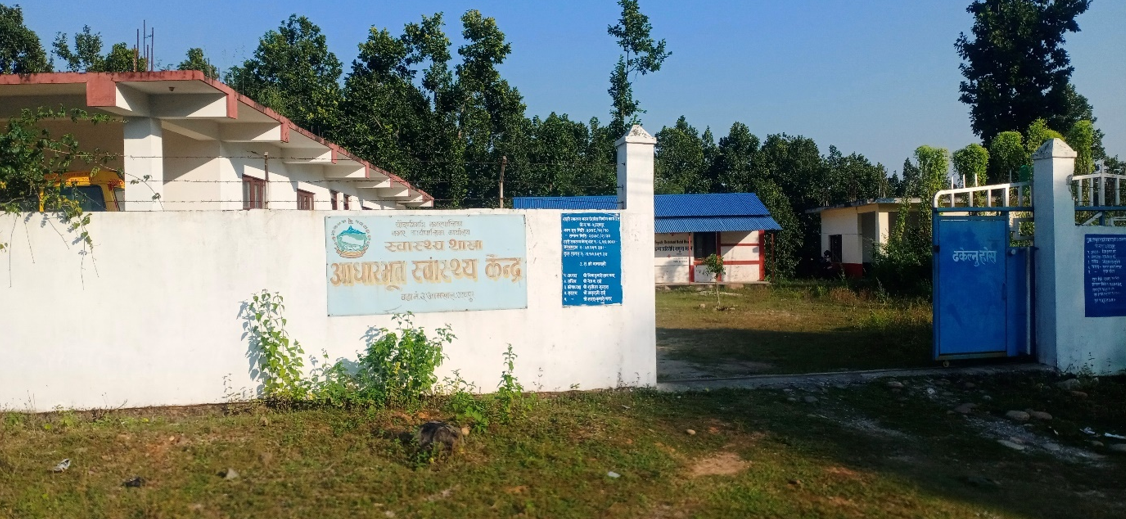
Currently, general level health services in the municipality are being provided from the basic city hospital and health posts and health centers located here. There is one basic city hospital (Ward No. 7) Beltar, 5 health posts (Ward No. 4, 1, 8, 5, 9) and 6 basic health centers (3, 2, 6, 5, 10, 10) in operation in the municipality.
5.2.1 Details of Health Institutions
Table No. 44: Details of Health Institutions in the Municipality
| SN | Name of Health Institution | Address | Service |
|---|---|---|---|
| 1. | Basic Municipal Hospital | Chau.Mun.– 7 | Emergency/OPD/Warding |
| 2. | Health Post Basaha | Chau.Mun.– 4 | OPD/Warding |
| 3. | Health Post Chaudandi | Chau.Mun.– 1 | OPD/ ANC |
| 4. | Health Post Sindhipur | Chau.Mun.– 8 | OPD/Warding |
| 5. | Health Post Sundarpur | Chau.Mun.– 5 | OPD/Warding |
| 6. | Health Post Hadiya | Chau.Mun.– 9 | OPD/Warding |
| 7. | Basic Health Center Amsal | Chau.Mun.– 3 | OPD/ ANC |
| 8. | Basic Health Center Madiwas | Chau.Mun.– 2 | OPD/ ANC |
| 9. | Basic Health Center Siwani | Chau.Mun.– 6 | OPD/ ANC |
| 10. | Basic Health Center Siwai | Chau.Mun.– 5 | OPD/ ANC |
| 11. | Basic Health Center Hadiya | Chau.Mun.– 10 | OPD/ ANC |
| 12. | Basic Health Center Khairaha | Chau.Mun.– 10 | OPD/ ANC |
Source: Municipal Health Branch
5.2.2 Immunization Services and Safe Motherhood Details
a) Immunization Details
Children are the builders of the future. For this, they need to be healthy and disease-free. In childhood, they must be given BCG once, DPT three times, Measles once, Polio and Vitamin in prescribed amounts. For children, all five vaccines must be given regularly and in full doses. The Government of Nepal has placed the National Immunization Program at a high priority. The immunization program is an effective effort in the health sector carried out in a low-cost and economical manner. The immunization program has significantly helped in reducing child mortality and preventing various diseases. This has helped in achieving the Sustainable Development Goal of reducing child mortality (MDG-4).
Table No. 45: Immunization Details
| SN | Indicators | Shravan 2079 / Ashad 80 | Shravan 2080 / Ashad 81 | Shravan 2081 / Ashad 82 |
|---|---|---|---|---|
| 1 | % of 1 year children immunized with rota2 | 76.38 | 82.87 | 72.33 |
| 2 | % of children 1 year imminized with DPT-HepB-Hib3 | 81.51 | 81.49 | 73.49 |
| 3 | % of children 1 year immunized with DPT-HepB-Hib1 | 80.7 | 81.06 | 74.77 |
Source: Municipal Executive Office
Fatal diseases that can occur during childhood and adulthood such as Tuberculosis, Diphtheria, Pertussis, Tetanus, Hepatitis B, Influenza Type B, Polio, Pneumonia, Measles, Rubella and Japanese Encephalitis must be vaccinated against compulsorily in a phased manner on time. These vaccines are respectively BCG, DPT, OPV, PCV, IPV, MR, JE / ID. Thus, vaccinating on time is an effective way to control child mortality by being free from the risk of major diseases with limited investment.
b) Details of Safe Motherhood Status
If children cannot be cared for and looked after from when they are in the womb and after birth, they are at risk of being infected by various diseases. While in the womb, the health of children depends primarily on the mother's age, nutrition, rest, consumption of alcohol and tobacco products, etc. For a child to be born healthy, a pregnant woman must have regular health check-ups at least four times and must regularly consume necessary vaccines (T.T.) and iron, vitamin tablets. Since becoming pregnant at a young age causes harm to the health of both the mother and the infant, the government has legally set the minimum age for marriage at 20 years. However, 17 percent of adolescents become pregnant or mothers between the ages of 15 and 19 (Nepal Demographic and Health Survey, 2011). The government is conducting community-based programs for safe motherhood and newborn health through the Department of Health Services.
5.2.3 Child Health and Malnutrition Status
The nutritional status of any place can be easily estimated by looking at the children of that place. Nourished children can be seen as an indicator of the social and economic development of any place. The government has also prioritized nutrition and has been regularly estimating child growth for children under 5 years of age. Even the Convention on the Rights of the Child, 1989, mentions that children must be protected from neglect, indifference, negligence, abuse, violence etc. and their right to food and nutrition must be ensured. The Constitution of Nepal (2072) has also placed food sovereignty as a fundamental right. Since health and nutrition are the first important needs of human life and other development activities of the nation cannot be effective without healthy citizens, public health study becomes an important part of the planning process. In this municipality, based on the national policy and program, the Child Nutrition Allowance provided by the Government of Nepal is being effectively monitored to improve nutrition, and arrangements are being made to improve the nutrition of children, and programs like the Multi-sectoral Nutrition Program are being conducted effectively by taking lessons from the past. Apart from this, national and international organizations are also working to carry out activities related to health and nutrition.
Table No. 46: Child Health and Malnutrition Status
| Indicators | Shravan 2079 / Ashad 80 | Shravan 2080 / Ashad 81 | Shravan 2081 / Ashad 82 |
|---|---|---|---|
| Percentage of children aged 0-11 months registered for growth monitoring | 90 | 86 | 72 |
| Average visit for growth nonitoring 0-23 months children | 7.01 | 7.26 | 7.66 |
| Percentage of postpartum women who received Vitamin A supplementation | 105 | 97 | 102 |
| Percentage of women who received 180 days supply of Iron Folic Acid during pregnancy | 56 | 49 | 50 |
| Percentage of postpartum women who received 45 days supply of IFA | 34 | 26 | 21 |
| Number of Adeolescent girls received Iron and Folic acid (13 weeks) | 0 | 0 | 1 |
| Number of Adelescent girls received Iron and Folic acid (26 weeks) | 0 | 0 | 1 |
Source: Municipal Executive Office
5.2.4 Details of Major Diseases and Treatment
The details of the top 10 major health problems seen recently according to the number of patients registered in the OPD of health institutions under this municipality are mentioned in the table below.
Table No. 47: Details of Top 10 Major Health Problems
| SN | Major Diseases |
|---|---|
| 1. | Gastritis |
| 2. | URTI |
| 3. | LRTI |
| 4. | Fever |
| 5. | Headache |
| 6. | PID |
| 7. | Cancer |
| 8. | Heart Disease |
| 9. | Chronic Kidney Disease |
| 10. | Spinal Injruries |
Source: Municipal Executive Office
5.2.5 Safe Motherhood
a) Family Planning
Research conducted by various organizations on the benefits of family planning has proven that it plays a significant role in improving the health of mothers, children, and newborns. It also helps in gender equality, women's education, and growth and development. Therefore, with the aim of providing quality family planning services, the reproductive health program and family planning program have been expanded since 1991 to hospitals, health posts, basic health centers, and urban clinics, and services are being provided through female community health volunteers. The details of family planning programs in the municipality are presented in the table.
Details related to Family Planning
| Temporary Method | New Users | Currently Using | Irregular in Service | Method Distribution | ||
|---|---|---|---|---|---|---|
| 20 Years | 20 Years | Unit | Quantity | |||
| Condom | Pcs | 25215 | ||||
| Emergency Contraceptive Pill | 1 | 3 | Dose | 4 | ||
| Pills | 9 | 277 | 3220 | 265 | Cycle | 3163 |
| Depo | 12 | 213 | 4765 | 830 | Dose | 1361 |
| Sayana Press | Dose | |||||
| IUCD | 1491 | 39 | Set | |||
| Implant | 1 | 54 | 8725 | 150 | Set | 68 |
b) Details of children born, living and dead based on child's gender and mother's age group
Table No. 48: Details of children born, living and dead based on child's gender and mother's age group
| Gender | Mother's Age Group | Total | ||||||
|---|---|---|---|---|---|---|---|---|
| 15-19 | 20-24 | 25-29 | 30-34 | 35-39 | 40-44 | 45-49 | ||
| Total Children Born | ||||||||
| Son | 131 | 764 | 1655 | 1985 | 2333 | 2310 | 2035 | 11213 |
| Daughter | 108 | 772 | 1497 | 1951 | 2131 | 2173 | 1934 | 10566 |
| Total | 239 | 1536 | 3152 | 3936 | 4464 | 4483 | 3969 | 21779 |
| Children Living Till Date | ||||||||
| Son | 126 | 745 | 1613 | 1937 | 2247 | 2219 | 1931 | 10818 |
| Daughter | 108 | 761 | 1475 | 1922 | 2071 | 2114 | 1876 | 10327 |
| Total | 234 | 1506 | 3088 | 3859 | 4318 | 4333 | 3807 | 21145 |
| Deceased Children | ||||||||
| Son | 5 | 19 | 42 | 48 | 86 | 91 | 104 | 395 |
| Daughter | 0 | 11 | 22 | 29 | 60 | 59 | 58 | 239 |
| Total | 5 | 30 | 64 | 77 | 146 | 150 | 162 | 634 |
Out of a total of 21,779 children born alive in the last 12 months to women aged 15 to 49 years in the municipality, the number of surviving children till date is 21,145. Similarly, the number of children who died during the same period is 634, the detailed description of which according to gender is presented in the table.
c) Details of mother's age at first birth
From the legal and reproductive health perspective, becoming a mother at the age of 20 or less is considered illegal and risky from the perspective of both maternal and child health. Conception and giving birth in a state of physical, mental, and economic immaturity carries a high risk of birthing an immature, underweight, physically and intellectually disabled infant on the one hand, and on the other hand, due to lack of adequate information on subjects like pregnancy care, mother and child care, nutrition, sanitation, there is a possibility that both mother and infant may fall victim to various types of infections. Nepal has achieved remarkable progress in the field of maternal and child health between the Millennium Development Goals 2000-2015. Considering 1990 as the base year, child mortality under 5 years of age (per thousand) has dropped to 38 by 2015 from 108 deaths per 1000 live births in Nepal. Similarly, considering 1990 as the base year, maternal mortality (per one hundred thousand) has dropped to 258 by 2015 from 850, and statistics show that the proportion of women giving birth from trained health workers has reached 55.6 percent (Nepal and the Millennium Development Goals Final Status Report, 2000- 2015). Looking at this, signs of positive impact in the overall field of maternal and child health are being seen in the municipality.
Table No. 49: Population of women according to number of children born alive till date by married women of 15-49 age group
| Mother's Age at First Birth | ||||||||
|---|---|---|---|---|---|---|---|---|
| Children currently alive | 15-19 Years | 20-24 Years | 25-29 Years | 30-34 Years | 35-39 Years | 40-44 Years | 45-49 Years | Total Married Women |
| No Child | 199 | 443 | 256 | 129 | 76 | 82 | 103 | 1288 |
| 1 Child | 188 | 840 | 851 | 532 | 274 | 190 | 121 | 2996 |
| 2 Children | 22 | 290 | 778 | 950 | 871 | 618 | 332 | 3861 |
| 3 Children | 1 | 32 | 171 | 325 | 446 | 483 | 383 | 1841 |
| 4 Children | 1 | 5 | 50 | 87 | 163 | 208 | 199 | 713 |
| 5 Children | 0 | 0 | 4 | 29 | 58 | 96 | 127 | 314 |
| 6 Children | 0 | 0 | 2 | 6 | 17 | 31 | 53 | 109 |
| 7 Children | 0 | 0 | 0 | 0 | 6 | 11 | 28 | 45 |
| 8 Children | 0 | 0 | 0 | 0 | 3 | 3 | 4 | 10 |
| More than 9 Children | 0 | 0 | 0 | 0 | 0 | 1 | 6 | 7 |
| Total | 411 | 1610 | 2112 | 2058 | 1914 | 1723 | 1356 | 11184 |
| Percentage | 3.67 | 14.40 | 18.88 | 18.40 | 17.11 | 15.41 | 12.12 | 100 |
Out of total 11,184 women in the municipality, 411, i.e., 3.67 percent women seem to have given birth to their first child between 15-19 years. Similarly, 1,610 i.e., 14.40 percent women at 20-24 years age, 2,112 i.e., 18.88 percent women at 25-29 years age and 2,058 i.e., 18.40 percent women seem to have become mothers at 30-34 years age, while the number of those becoming mothers for the first time above 35-39 years is total 1,914 i.e., 17.11 percent. Similarly, women of 40-44 years are 1,723 i.e., 15.41 percent, while 1,356 i.e., 12.12 percent women of 45-49 years have given birth to their first child.
5.2.6 Details of Married and Unmarried Men and Women
Table No. 50: Details of Married and Unmarried Men and Women
| SN | Marital Status | Male | Female | Total | Percentage |
|---|---|---|---|---|---|
| 1. | Unmarried | 7953 | 6845 | 14798 | 33.24 |
| 2. | Married | 12021 | 15252 | 27273 | 61.27 |
| 3. | Single (Widower/Widow) | 455 | 1720 | 2175 | 4.89 |
| 4. | Divorced | 27 | 37 | 64 | 0.14 |
| 5. | Separated | 90 | 116 | 206 | 0.46 |
| Total | 20546 | 23970 | 44516 | 100 | |
Source: National Census, 2078
5.3 Water and Sanitation
Since clean water and sanitation are the main factors affecting human health and Sustainable Development Goal No. 6 ensures drinking water and sanitation, and the Constitution of Nepal also interprets drinking water and sanitation facilities as a fundamental right of citizens, there is a need to construct additional drinking water projects by giving high priority to the sector of quality drinking water and sanitation to contribute to the production of healthy citizens, and also to manage waste using scientific methods.
5.3.1 Water Source Details
Table No. 51: Details of households based on main source of drinking water
| Ward No. | Tap/Pipe (Inside) | Tap/Pipe (Outside) | Tubewell/Handpump | Covered Well | Uncovered Well | Spout | River/Stream | Jar/Bottle | Other | Total |
|---|---|---|---|---|---|---|---|---|---|---|
| 1 | 288 | 217 | 2 | 2 | 244 | 3 | 17 | 0 | 0 | 773 |
| 2 | 89 | 609 | 362 | 22 | 53 | 1 | 1 | 0 | 7 | 1144 |
| 3 | 524 | 57 | 40 | 277 | 58 | 43 | 0 | 0 | 1 | 1000 |
| 4 | 129 | 481 | 621 | 195 | 235 | 1 | 3 | 0 | 3 | 1668 |
| 5 | 47 | 5 | 1423 | 3 | 26 | 1 | 0 | 1 | 17 | 1523 |
| 6 | 969 | 281 | 49 | 8 | 25 | 2 | 0 | 0 | 18 | 1352 |
| 7 | 974 | 284 | 65 | 18 | 80 | 2 | 0 | 0 | 4 | 1427 |
| 8 | 229 | 452 | 54 | 10 | 104 | 2 | 3 | 5 | 2 | 861 |
| 9 | 443 | 70 | 1223 | 28 | 20 | 3 | 3 | 0 | 16 | 1806 |
| 10 | 377 | 74 | 557 | 65 | 62 | 10 | 2 | 1 | 1 | 1149 |
| Total | 4069 | 2530 | 4396 | 628 | 907 | 68 | 29 | 7 | 69 | 12703 |
| Percentage | 32.03 | 19.92 | 34.61 | 4.94 | 7.14 | 0.54 | 0.23 | 0.06 | 0.54 | 100 |
Out of 12,703 households in this municipality, generally most drink water from tubewell/handpump, numbering 4,396 i.e. 34.61 percent. Similarly, the number of families drinking Tap/Pipe (Inside Premises) water is 4,069 i.e. 32.03 percent, and those drinking from Tap/Pipe (Outside Premises) is 2,530 i.e. 19.92 percent. Generally, most households drinking uncovered well water number 907 i.e. 7.14 percent, while those drinking covered well water are 628 i.e. 4.94 percent. Similarly, households drinking Spout water are 68 i.e. 0.54 percent, River/Stream water 29 i.e. 0.23 percent, Jar/Bottle users 7 i.e. 0.06 percent and other water source users are 69 i.e. 0.54 percent. Detailed ward-wise description is presented in the table.
Source: National Census, 2078
Details of households based on main source of drinking water
Sustainable Development Goals Status & Roadmap: According to 2016-2030 (SDG-6), in the base year 2015, only 15 percent of the population is seen consuming safe drinking water. According to the document which also mentions the sustainable development goal monitoring framework, this population is expected to increase gradually. Accordingly, ambitious targets have been set to reach 35 percent in 2019, 50 percent in 2022, 65 percent in 2025 and 90 percent of the total population as safe drinking water users by 2030. To support the achievement of the said national goal and to improve the public health of the general public, it seems necessary to spread widespread public awareness about testing the suitability of water and safety measures while using water.
5.3.2 Toilet Usage Status
In many remote urban settlements, people still defecate in water sources and open places. For a civilized society, this practice is a symbol of incivility. Disposal of excreta in open areas allows germs to enter human body through food, water and breathing. Therefore, construction of toilets in every house is a mandatory requirement. Nowadays, the government and various non-governmental organizations are prioritizing toilet construction. Private houses and public places must have toilets with handwashing water. In case families from poor communities cannot build toilets themselves, the government, especially the local government, has to provide subsidies for toilet construction.
Table No. 52: Details of households based on type of toilet used
| Ward No. | Flush (Public Sewer) | Flush (Septic Tank) | Pit Latrine | Community Toilet | No Toilet | Total |
|---|---|---|---|---|---|---|
| 1 | 20 | 265 | 443 | 2 | 43 | 773 |
| 2 | 108 | 607 | 407 | 4 | 18 | 1144 |
| 3 | 3 | 337 | 647 | 1 | 12 | 1000 |
| 4 | 16 | 329 | 1258 | 23 | 42 | 1668 |
| 5 | 23 | 407 | 1029 | 8 | 56 | 1523 |
| 6 | 14 | 401 | 912 | 6 | 19 | 1352 |
| 7 | 65 | 613 | 716 | 3 | 30 | 1427 |
| 8 | 28 | 23 | 759 | 8 | 43 | 861 |
| 9 | 65 | 472 | 1197 | 9 | 63 | 1806 |
| 10 | 17 | 235 | 873 | 5 | 19 | 1149 |
| Total | 359 | 3689 | 8241 | 69 | 345 | 12703 |
| Percentage | 2.83 | 29.04 | 64.87 | 0.54 | 2.72 | 100 |
Source: National Census, 2078
Among the total households in the municipality, 64.87 percent use Pit Latrine, 29.04 percent use Flush (Septic Tank), 2.83 percent use Flush (Public Sewer), 0.54 percent use Community Toilet and 2.72 percent do not use toilets and defecate in open places. Detailed ward-wise description is mentioned in the table.
Details of households based on type of toilet used
5.3.3 Details of Public Toilets
Private houses and public places must have toilets with handwashing water. In case families from poor communities cannot build toilets themselves, the local government has to provide subsidies for toilet construction. Public toilets have been constructed in various places to make the home courtyards, roads, markets and public areas of this municipality clean. The Tole Health Committee and the Municipality must play an important role in keeping public toilets clean. By charging a fee for using public toilets, money can be spent on cleaning and management of toilets. In addition to keeping home courtyards, markets and roads clean, it can also support the municipality's revenue. Although there are not enough public toilets in this municipality, the details of existing public toilets are mentioned in the table.
Table No. 53: Details regarding public toilets
| SN | Location of Toilet | Ward No. | Number |
|---|---|---|---|
| 1 | Barshe Danda and Shanibare | 4 | 2 |
| 2 | Sundarpur (Ward premises road and Shivalaya Park) | 5 | 2 |
| 3 | Beltar Buspark and Kauwakhoj | 6 | 2 |
| 4 | Charghare, Ranitar and Gadhi | 1 | 3 |
| 5 | Bandel Pani and Bhorleni | 3 | 2 |
| 6 | Jyamire | 9 | 1 |
| 7 | Hadiya | 10 | 1 |
Source: Office of the Municipal Executive
5.3.4 Details of Households regarding Waste Management
Especially in urban areas and market centers where population density is high, human-generated waste and waste from industries and factories not only disfigure the beauty of the settlement but also have detailed negative impact on public health. In such a situation, the waste management system must be addressed in a long-term manner from both the government and community sides. Realizing that waste harms both health and beauty, proper management of waste is necessary. Organic fertilizer can also be made from some biodegradable waste. The municipality has put forward policies and programs including making necessary arrangements for sewage drainage in markets/settlements within the city area for waste management, making the Tole Development Institution responsible for adopting a zero-cost policy in waste management, and sustainable management of waste in collaboration with Beltar Basaha Chamber of Commerce and Industry, Tole Development Institution and stakeholders under the leadership of Market Management and Development Committee.
Problems seen in waste management:
Currently, the problems seen in this municipality are as follows:
In the name of waste management, the tendency to throw waste uncontrollably in the low-lying areas of rivers and streams is seen everywhere. The waste thrown in this way is washed away by water during the rainy season and reaches the lower parts of rivers and streams, expanding pollution.
Since the low-lying parts of the land are also sources of water and the same water appears on the surface and seeps into the ground, the waste thrown in the low-lying parts pollutes specifically the surface water and the groundwater.
Things to pay attention to in waste management:
Separating kitchen waste into biodegradable and non-biodegradable.
The municipality should conduct training to use biodegradable waste for fertilizer and programs to motivate every homeowner.
Separating non-biodegradable waste into different levels such as wood, plastic, metal, glass. After identifying these wastes as needed, emphasizing the management of related services for those that can be reused. Arranging for scientific selection in open places of this municipality area where there are no water sources.
5.3.5 Status of Sewerage and Landfill Site
It is necessary to have good arrangement of drainage in places with city market centers and integrated settlements. Drainage is also an important infrastructure of physical development. If drainage management is done along with road construction, the government saves double expenditure on infrastructure development. Apart from this, waste emitted from human settlements should be managed by creating a landfill site at a certain distance from human settlements. A clean and waste-free environment is a hallmark of civilization.
The municipality has not been able to make proper arrangements for drainage appropriately. However, the municipality is committed to moving forward by formulating an urban development plan. A specific landfill site has not been arranged in the municipality area for waste management. Regarding drainage, the municipality has put forward policies such as making necessary arrangements for drainage in markets/settlements of the municipality area, making the Tole Development Institution responsible for adopting a zero-cost policy in waste management, and beautifying markets under the municipality including Beltar market.
5.3.6 Status of Children without Families
Under Article 39, clause 9 of the Constitution of Nepal, regarding fundamental rights, it is mentioned that helpless, orphan, disabled, conflict victims, displaced and at-risk children shall have the right to special protection and facilities from the state, while Article 43 mentions that economically poor, incapacitated and helpless, helpless single women, disabled, children, citizens who cannot take care of themselves and citizens of endangered tribes shall have the right to social security according to law. Therefore, the municipality as a local government has an obligation to mandatorily protect children and other citizens in such helpless conditions.
5.4 Youth, Sports and Entertainment
5.4.1 Details regarding Sports Fields, Parks, Picnic Spots and Entertainment Places
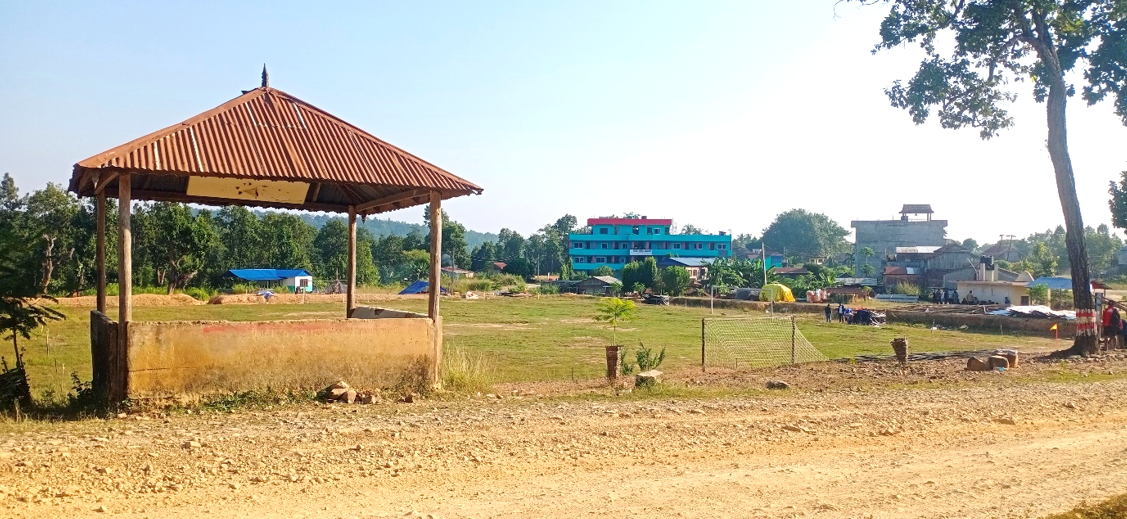
Bhorleni Playground
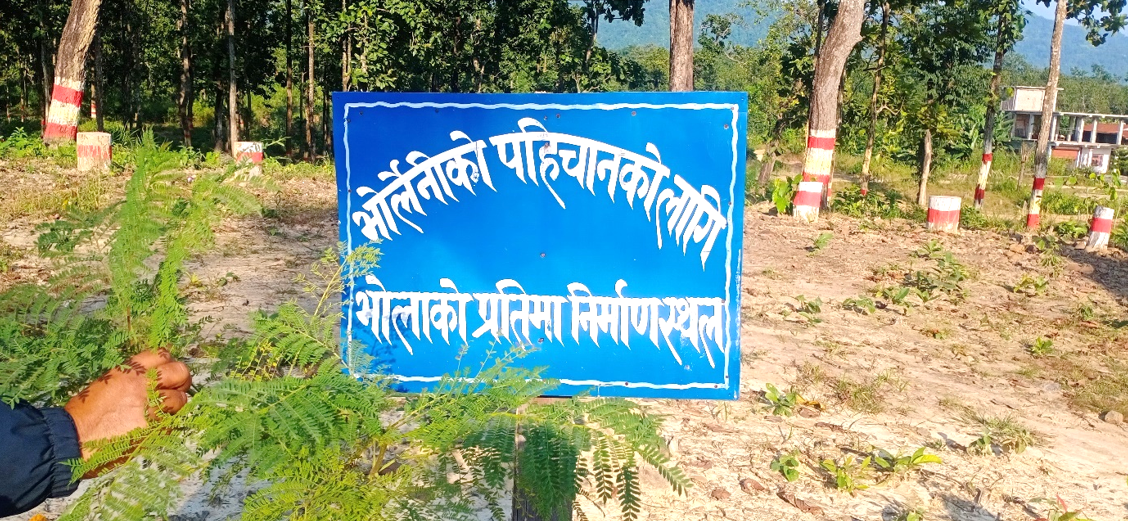
Bhorleni Picnic Spot
According to the belief that sports discipline and sports development of the municipality can be strengthened by producing healthy, competitive manpower in the sports sector, sports development is found in this municipality. Playgrounds are located in Ward No. 2, Ward No. 4, Ward No. 5, Ward No. 6, Ward No. 7 and Ward No. 8 of this municipality, and the condition of these playgrounds is normal. Overall, it seems that there is very little investment in the field of sports, which is indispensable for the healthy physical development of children and youth manpower. There is a need to invest a huge amount to repair the sports infrastructure built in the past.
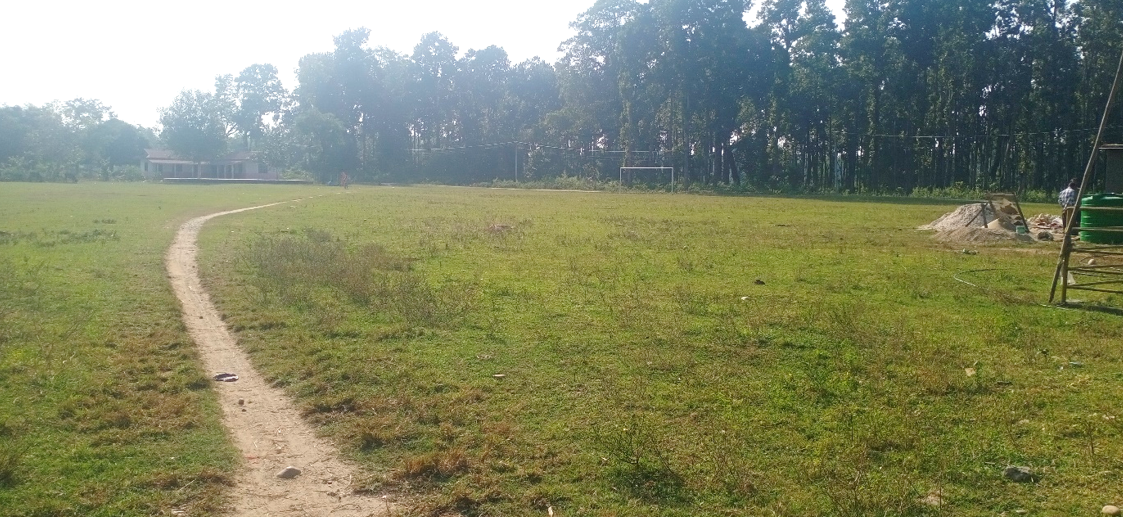
Sundarpur Playground
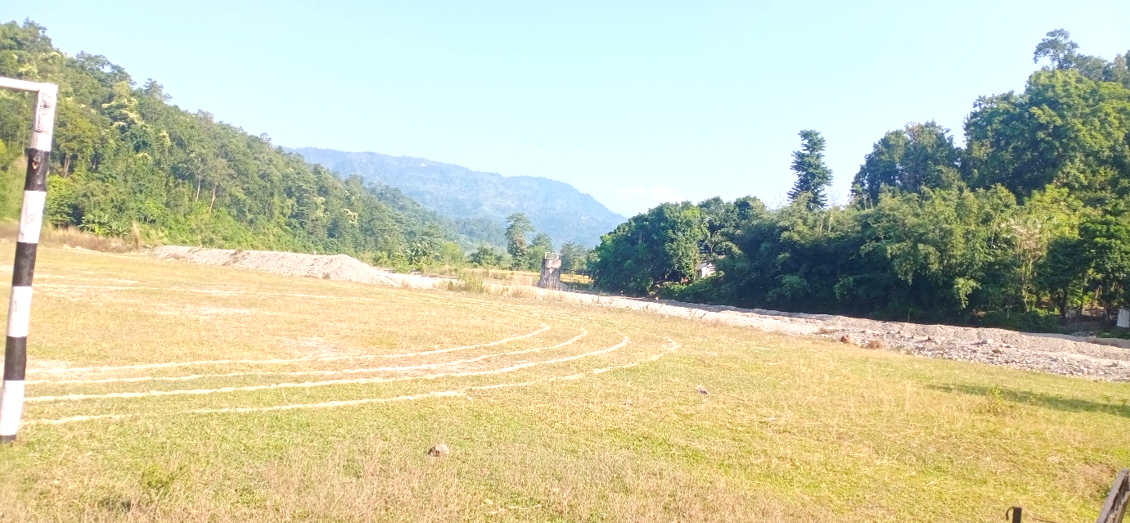
Duwar Playground
Although there are no national and international level sports grounds for entertainment in the municipality, people here are found taking entertainment in volleyball and football grounds, open lands, meadows, parks, but those open lands, meadows and playgrounds have not yet developed as organized grounds. Farmers here spend much time in their fields and in their free time they are found enjoying the local nature there and doing entertainment activities within their reach. Details regarding sports grounds in the municipality are mentioned in the table.
Table No. 54: Details regarding Stadiums and Sports Fields
| SN | Playground | Address |
|---|---|---|
| 1 | Gymnasium, Covered Hall, Badminton Court, Naradmuni Playground- Basaha | Ward No. 4 |
| 2 | Gymnasium, Cricket Ground (Satdhare), Covered Hall, Sirwani and Kechuwa Playground | Ward No. 6 |
| 3 | Covered Hall and Playground (Sundarpur), Badminton Court, Siwahi Playground, Khoriya Tole Playground | Ward No. 5 |
| 4 | Jhora Pata Badminton Court | Ward No. 2 |
| 5 | Duwar Hang (Shree Panchami) Playground, Forest Office Premises Playground, Sahid Smarak Playground, Devisthan Danda Playground, Sagarmatha Playground, Lamechaur Playground | Ward No. 7 |
| 6 | Bhorleni Playground, Bandel Pani Playground, Rajanagi Playground, Hattisar Playground | Ward No. 3 |
Source: Office of the Municipal Executive
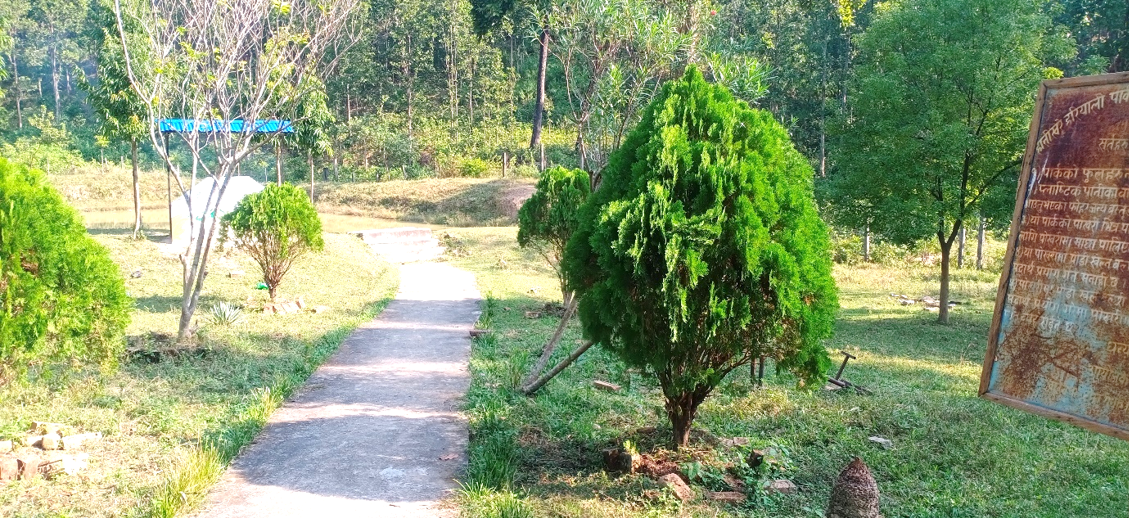
Hattikhore Park
Parks and gardens in the municipality are public properties. It is necessary to protect these areas to promote green zones by securing the environmental system of the municipality. Entertainment is needed for mental vigor and cleanliness by staying away from daily regular work. Among various means of entertainment, enjoying clean and natural environment and picnicking is a universal and ancient practice.
If gardens, parks and playgrounds serving as public heritage can be sustainably preserved, developed and expanded, these areas become extremely necessary and important in terms of environmental significance as the municipality develops and expands. These areas help maintain the natural beauty of the municipality as resting places in the form of green zones.
5.4.2 Details of Youth Clubs
Table No. 55: Details of Youth Clubs and Sports Clubs in the Municipality
| SN | Name of Youth Club and Sports Club | Ward No |
|---|---|---|
| 1 | Sirjana Youth Club | 3 |
Source: Office of the Municipal Executive
5.5 Art, Language and Culture
5.5.1 Public Places, Pati, Pauwa and Chautara
Pati, Pauwa, Dharmashala, Chautara and resting places are our cultural identities. These traditional structures represent our ancestral culture. Therefore, by preserving, promoting and upgrading these structures, we must introduce future generations to our tradition and culture. If we do this, our traditional original identity will be saved. In the process of building modern structures of development, we need to pay special attention to the conservation of original cultural heritage.
Roads, cattle outlets, grazing fields, canals, irrigation channels, ponds, pati, pauwa, cremation sites, religious sites or any other public use sites or properties that have been used publicly since time immemorial and are not owned by anyone are public properties. In the past, when road transportation was not expanded and developed, these pati, pauwa and chautaras developed as resting places (Refresh Centers) for travelers or important places to relieve fatigue, and now these places serve as informal venues for public debate and community interaction, while in places where road networks are not properly developed, they are still being used as resting places. It is the responsibility of all of us to develop and protect such areas. Details regarding public places, pati, pauwa and chautaras in the municipality are presented in the table.
Table No. 56: Details regarding Public Places, Pati, Pauwa and Chautara in the Municipality
| SN | Public Place, Pati, Pauwa and Chautara | Address |
|---|---|---|
| 1 | Pushpalal Chowk (Market Area), Shivalaya Temple, Kauwa Khoch (Kuwakhani), Kali Temple Premises | Ward No. 6 |
| 2 | Ban Batika, Bhimsensthan, Gadhi Than | Ward No. 10 |
| 3 | Hattikhore Park, Duwar Hang Area, Mate Khadi, Duwar Khola Premises-Pashu Hat Area (Upper Beltar) | Ward No. 7 |
| 4 | Jhorapata Open Field Area, Badele, Jhora Pata | Ward No. 2 |
| 5 | Jyamire Pati and Picnic Spot, Than Pokhari Premises (4 Ponds), Bhim Sarder Spot | Ward No. 9 |
| 6 | Siddhipur, Aprah, Dharapani | Ward No. 8 |
| 7 | Gadhi, Simpani Open Area, Kanchanpur (Park and Open Area), Batasedanda, Charghare | Ward No. 1 |
| 8 | Aamsal, Bhorleni (Park and Playground), Bandel Pani, Hattisar | Ward No. 3 |
| 9 | Sundarpur Pokhari (Reservoir 3 Ponds), Sundarpur Park, Pandav Bas (Lower and Upper) Playground, Gher Tole, Bhela Chaur, Siwahi | Ward No. 5 |
| 10 | Barshe Danda, Shanibare, Teen Dobhane | Ward No. 4 |
Source: Office of the Municipal Executive
5.5.2 Details of Local Festivals, Jatras and Melas
People of various castes, religious sects and costumes live in this municipality. Most of the people here follow Hindu religion, while some people following Kirat, Buddhist, Christian, Islam, Nature religion also live here. All castes and sects have their own kind of religion, culture and customs. Among which Bada Dashain, Tihar, Ram Navami, Maha Shivaratri, Haritalika, Shree Panchami, Shree Krishna Janmashtami, Vivah Panchami, Holi, Chaite Dashain, Saune-Maghe Sankranti, Matatirtha Aunsi, Akshaya Tritiya, Harishayani-Haribodhini Ekadashi, Nag Panchami, Rakshabandhan (Janai Purnima), Kushe Aunsi, Bala Chaturdashi, Kojagrat Purnima, Shree Swasthani Purnima, Ubhauli (Baishakh Purnima) and Udhauli (Mangsire Purnima), Bhume (Bhumya) Parva, Buddha Jayanti, Christmas Day, English New Year, Asar 15 etc. festivals are present. Details regarding local festivals, jatras and melas celebrated in this municipality are mentioned in the table.
Table No. 57: Details of Local Festivals, Jatras and Melas
| SN | Festival/Jatra/Mela | When Celebrated | Celebrating Caste/Community |
|---|---|---|---|
| 1 | Dashain, Tihar, Teej, Maghi, Holi Purnima, Krishna Janmashtami, etc. | Hindu | |
| 2 | Shivaratri, Saune Sankranti, Chaite Dashain | Hindu | |
| 3 | Maghe Sankranti, Teej, Krishna Janmashtami | Hindu | |
| 4 | Krishna Janmashtami | Bhadra | Hindu |
| 5 | Shivaratri Mela | Shivaratri | Hindu |
| 6 | Holi (Fagu Purnima) | Falgun | Hindu |
| 7 | Bhume (Bhumya) Parva | Hindu | |
| 8 | Christmas | Christian Community |
Source: Office of the Municipal Executive
5.6 Details of Peace and Security
As mentioned in the constitution, the state should be able to make citizens feel safe. It is the responsibility of the state to provide civil security to the citizens of every nation. Citizens should represent safe feeling in their state. Civil society also has an equally important role to play in making this effective.
Criminal and extra-social activities such as theft and robbery in the municipality are found to be resolved through these security agencies. It seems that hardly any unpleasant incident has been registered in this municipality throughout the year. Locals say that incidents of petty quarrels, beatings, disputes over boundaries, theft, robbery, fraud, and domestic violence occur occasionally in the municipality. Security agencies have been established in Ward No. 2, Ward No. 4, Ward No. 5, Ward No. 6 and Ward No. 10 within this municipality, the detailed description of which is presented in the table below.
Table No. 58: Details of Major Security Agencies in the Municipality
| SN | Name of Security Agency | Location |
|---|---|---|
| 1 | Area Police Office | Beltar Ward No 6 and Siwahi Ward No. 5 |
| 2 | Armed Police Force | Beltar Ward No. 6 |
| 3 | Police Station | Hadiya Ward No. 10 |
| 4 | Police Station | Barshe Danda and Basaha Ward No. 4 |
| 5 | Police Station | Madibas Ward No. 2 |
Source: Office of the Municipal Executive